The Problem
Real-estate lead handling is a leaky, impersonal funnel. Prospects call or fill out a form, then wait — sometimes hours, sometimes days. When a response arrives, it's generic: a template follow-up that tells the prospect they're a data point, not a person. Meanwhile, the human agent who would genuinely care is stretched across dozens of leads and can't respond to everyone well.
An AI agent can close this gap — respond instantly, qualify thoughtfully, and hand off warmly. But most implementations don't. They optimize capture at the prospect's expense: rapid extraction scripts, pressure tactics, "just let me know your budget" before "hello."
The brief I hold: build something that qualifies efficiently and treats the person on the other end with care. Prove those goals aren't a trade-off.
What I Designed
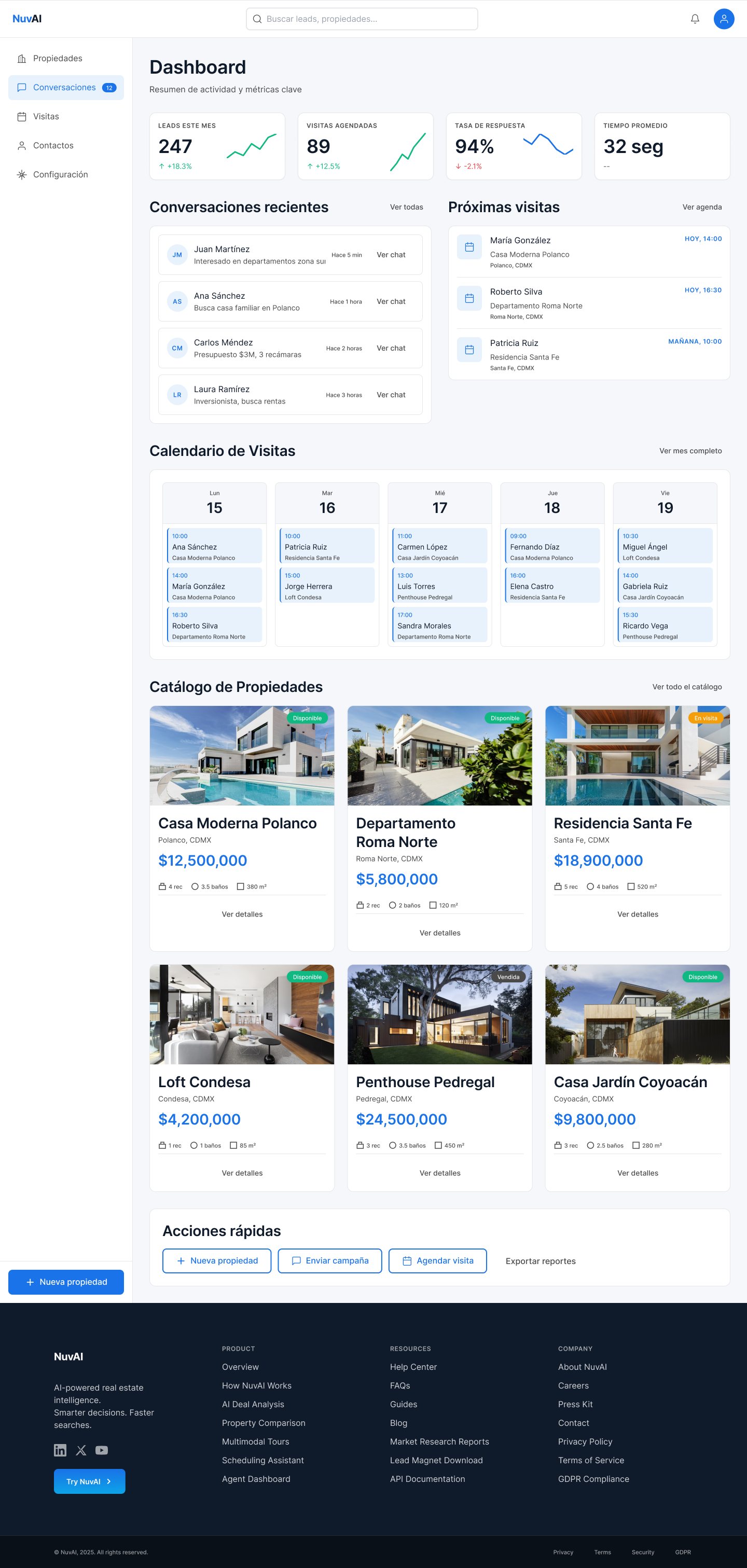
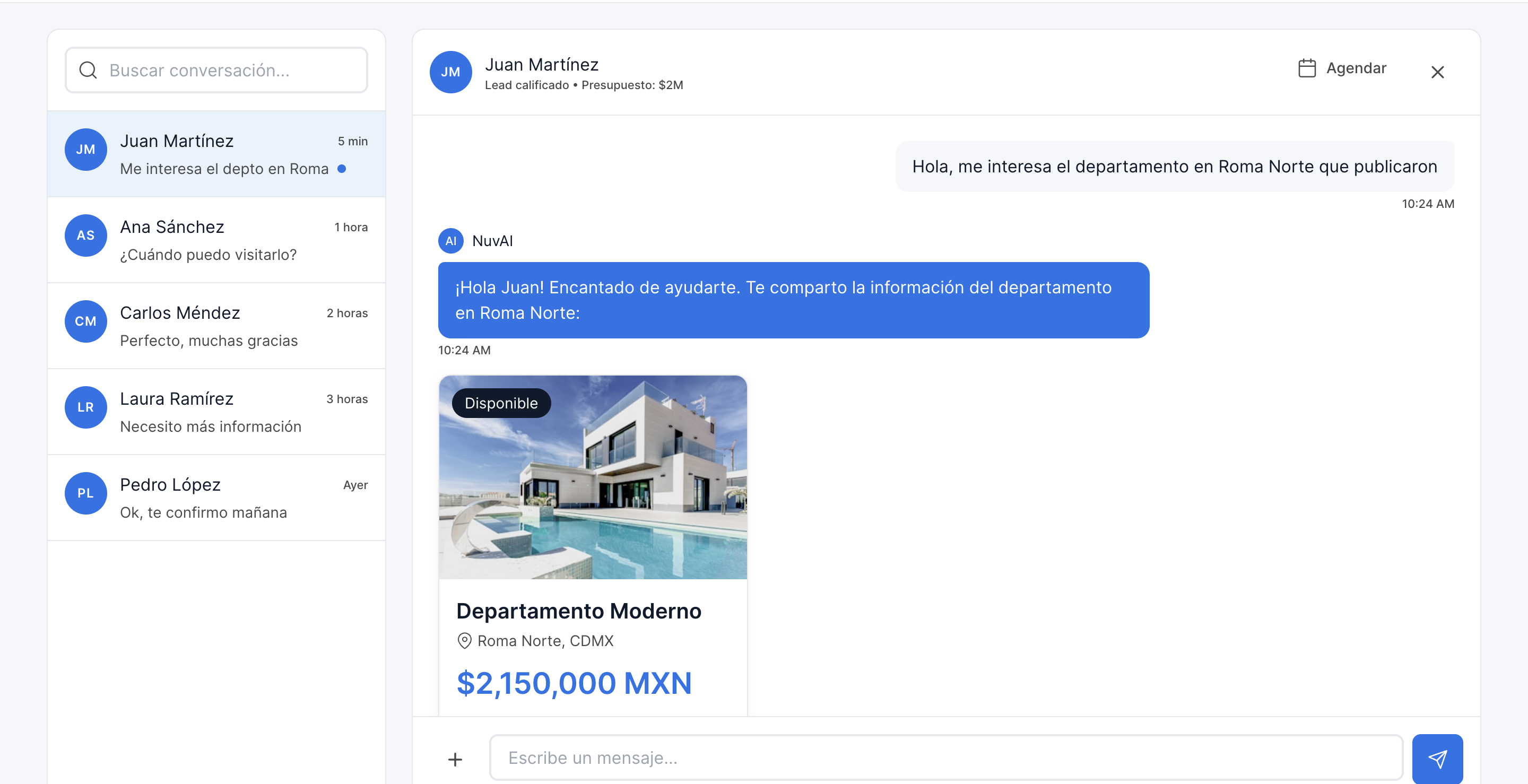
Service blueprint — the full arc
A service blueprint for the complete journey: capture → qualification → follow-through — mapping where the agent acts, where a human takes over, and where the handoff has to feel seamless. The blueprint is where the human-centered constraints live at the system level: who says what, when the agent yields to a person, and how information moves without the prospect ever having to repeat themselves.
Conversation design
The conversation is designed around three interaction constraints that most real-estate lead automation ignores. They hold for the text/chat interaction today, and they're the same principles a voice layer would have to honor if one ships later:
- Disclosure first. The agent identifies itself as an AI right up front, before it asks anything. No ambiguity, no theater.
- Pace to the person. The conversation follows the lead's rhythm, not a capture script's ideal sequence. If they want to talk about the neighborhood before the budget, the agent goes there.
- No pressure. The conversation ends whenever the person wants, and the agent says so. A qualified lead who felt respected is worth more than one who felt pressured into a callback slot.
Agent architecture
How the pieces fit: Claude for reasoning and conversation (the "brain" of the interaction) and n8n for orchestration (routing leads, triggering CRM updates, scheduling human handoffs). A dedicated voice layer (Vapi) is under evaluation for real-time telephony — it isn't part of the current build. Each layer is designed around the conversation experience, not the other way around — the technology follows the interaction, not the reverse.
Rules of Engagement
NuvAI itself is my solo build — every artifact on this page is mine. In parallel, a senior UX veteran and I opened a joint discovery track that set these designs aside to re-derive the product from research; it may become NuvAI’s next iteration or a different product entirely. Its foundation is an explicit collaboration document, written before that track’s first design artifact. It covers: values alignment (what we will and won't build), authorship (who owns which decisions), decision rights (who has veto on what), and exit terms (how the collaboration ends if it needs to).
This is a design artifact. Designing the working relationship with the same care as the product is the only way to ensure the product carries the right values when you're not looking.
Key Decisions
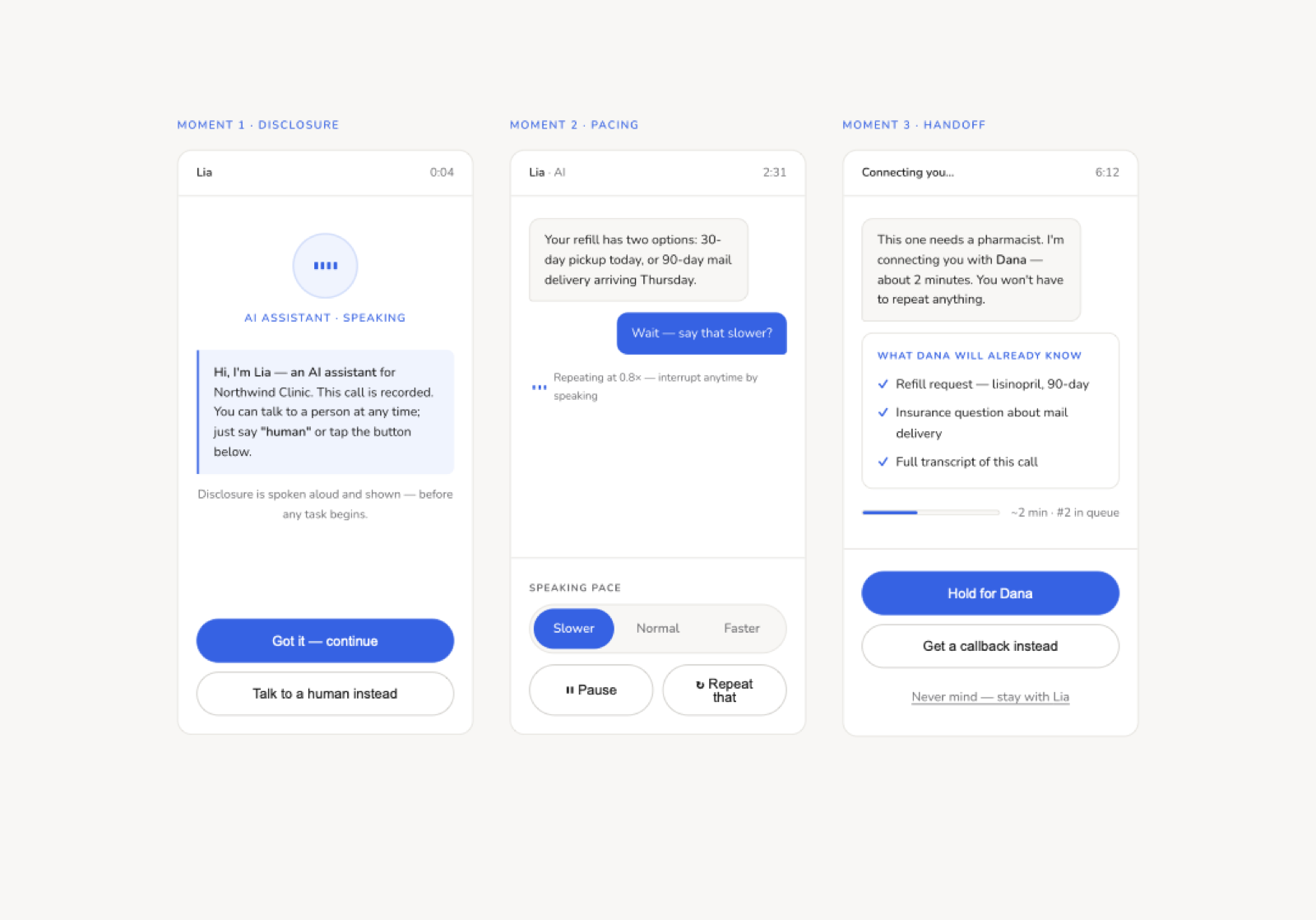
The agent identifies itself. The industry alternative — ambiguity about whether the person is dealing with a human — generates more initial conversions and causes lasting trust damage when discovered. A qualified lead who felt respected is worth more than one who felt tricked. This is also the ethical floor: people have a right to know they're talking to a machine.
Qualification scripts are optimized for data extraction speed. The conversation design here is optimized for the person's comfort. This produces a slower, calmer exchange and, we expect, higher qualified-lead quality — because a prospect who was never rushed is a prospect who gave accurate information and felt heard.
The Rules of Engagement were written before any design work. This prevented the ambiguity that usually breaks two-person discovery tracks — about authorship, about what the product is for, about what it refuses to do. The document is itself a design artifact: a proof that governance can be designed, not just hoped for.
Many AI voice products are designed around the capabilities of the telephony stack. This one was designed around the conversation, then the tech was selected to serve it. Claude was chosen because it can maintain context and values constraints across a variable-length conversation, with n8n orchestrating the workflow; a voice layer (Vapi) is under evaluation for how it handles interruption and natural pause.
Outcome (honest current state)
A working pipeline taking shape — service blueprint, conversation design, and agent architecture defined. The full end-to-end conversation flow is next. Framed as building, not shipped-at-scale — but this is where my AI-native, human-first practice is most concretely applied to a real product with real stakes.
NuvAI is the most "employable product" piece in the portfolio: a real conversational-AI surface with a service design layer behind it, built with the actual current stack (Claude + n8n), solving an actual market problem.
Reflection
The thing I want to measure when this ships: qualified-lead quality against the humane-design constraints. The hypothesis is that respecting the person and performing for the funnel aren't a trade-off — that disclosure, pacing, and no pressure produce better-quality qualified leads because the prospect gave accurate, uncoerced information.
If that hypothesis holds, it's the clearest possible proof that human-centered AI product design isn't a softening of performance goals. It's a more sophisticated model of what performance means.
If it doesn't hold — if disclosure and pacing measurably reduce qualification rates — that's also data worth having and worth writing up honestly.
How It Was Made
NuvAI is designed and built AI-assisted end to end, on the same stack the product itself runs on (Claude + n8n). That is deliberate: a conversational-AI product designed without using the tools would be a weaker argument than one designed with them.
The product direction, the constraints and every judgment call are mine. I note the method explicitly because it is how I work now — and because being vague about provenance would undercut the point.