The Problem
AI products are increasingly asking people to direct agents rather than click buttons — but nobody has settled what that interface should feel like. How does a person command, trust, oversee, and stay oriented among autonomous helpers without losing agency or getting lost in the process?
Enterprise AI dashboards are the default answer: rows of tasks, status columns, notification bells. They're functional, but they import all the cognitive overhead of project management software into a space that should feel light. I wanted to design this relationship from scratch — without the baggage — and I used a calm, breath-based world as the sandbox.
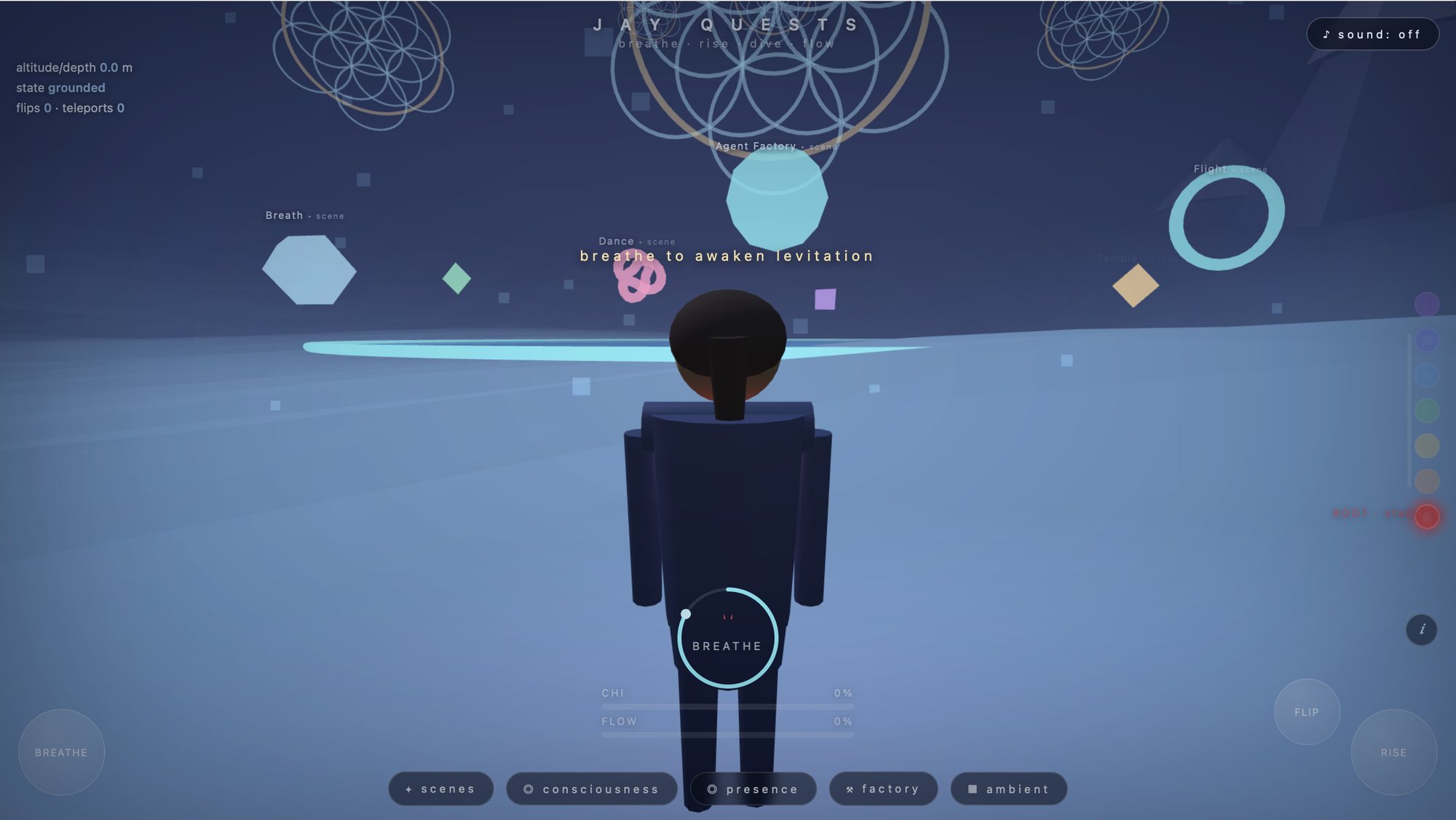
The world itself: breath builds energy, energy awakens a seven-stage progression, each stage unlocks movement (levitation, freediving, flight). But the spine of the project is its agent layer — and the design questions it forces you to answer.
What I Designed
A companion + an agent operating system
An always-present AI companion ("Lumen") and a "Mandala OS" of seven specialized agents — Anchor, Flow, Forge, Mend, Voice, Seer, Oracle — each with a defined domain of action. The user dispatches them by intent. The agents genuinely run a task lifecycle: idle → dispatched → working → returning — with live, legible status for each. The design question I was answering: how do you make autonomous work visible and trustworthy without overwhelming the person?
The solution wasn't more information. It was the right information: a single-state indicator per agent, a clear visual reading of "working" versus "waiting," and an ambient audio layer that changes character when agents are active — without requiring the person to look.
The Forge — a model of human oversight
A "factory" where the user manufactures a new agent through an explicit spec → build → verify loop. The human writes the intent (the spec). The AI builds the agent. The human must approve and deploy before anything goes live.
The Forge is a playable argument: human-in-the-loop is a design stance, not a setting. The approve-and-deploy gate could have been removed — the experience would be smoother without it. Making it mandatory is the thesis. You can't skip it.
A no-fail, calm-tech frame
A full state machine (attract → reveal → controls → world) with a 60-second idle fallback into an installation/projection mode. "You can never get stuck." Diegetic onboarding: the world teaches by feel and discovery, not by tutorial text. Synthesized ambient audio tuned to a slow breath rhythm that changes character as the experience deepens.

Key Decisions
I built a real task lifecycle with state and status rather than canned animations, because the point was to design for the trust gap that appears when work is genuinely autonomous. You can't design for trust if you've removed the uncertainty that makes trust necessary.
The Forge could auto-deploy. Making approval mandatory is the thesis: human-in-the-loop is a design stance, not a feature toggle. If a hiring team is looking for evidence that I take AI safety seriously at the interaction level, this is the proof.
No fail states, no score, no pressure. The questions of agency and trust only surface when the person isn't fighting the system. The world had to lower cognitive arousal rather than raise it — so the philosophical questions about autonomy and oversight could actually be felt.
The audio layer changes character when agents are active — a subtle signature that doesn't require looking. This is a small decision with disproportionate impact: it reduces the anxiety of "is something happening?" without adding a notification or a badge.
Outcome
A completed, running artifact that demonstrates — concretely, not theoretically — that I can design the interface of human-in-the-loop agent orchestration: dispatch, visible autonomous work, legible status, and mandatory human oversight, all inside a coherent, calm experience.
It's the clearest proof of my systems-thinking and AI-direction practice. The agent layer is the part that travels: the exact UX problem JAY plays with — how a person directs and oversees a system of AI agents without losing the thread — is the problem AI-native products are hiring designers to solve right now.
Reflection
JAY Quests and JAY Astral together form a complete statement: Quests proves I can design the orchestration of AI; Astral proves I can design its restraint and its ethics. Neither is sufficient alone.
Next steps: host it for a shareable link (it's currently running locally), and pull the Forge's spec→build→verify loop out as a standalone interaction study that can be presented to teams working on AI governance. The Forge pattern generalizes — it's a reusable model for any context where human approval before AI deployment matters.
What I'd measure if this had users: time-to-first-confident-dispatch, whether users trust the agents' status without re-checking, and comprehension of the approve-and-deploy gate. The last one is the most important — if people skip the gate without reading it, the thesis fails even if the experience is beautiful.