The Problem
The current paradigm for personal AI is cloud-first by default: your data, context, and memory live on a server belonging to someone else, processed by a model you don't control, in an infrastructure designed for the platform's interests. This is a reasonable trade-off for many use cases. It is not acceptable for a personal intelligence system designed to hold and act on your private knowledge, health data, mission state, and cognitive context.
The problem MARVIS addresses: how do you build a personal AI ecosystem that is genuinely intelligent — capable of memory, reasoning, multi-agent coordination, and long-context operation — while keeping the data, the knowledge, and the intelligence local and private? The answer is not to avoid the cloud entirely. It is to design the system so that privacy is built into the architecture, not left to policy.
MARVIS is the answer to that design problem, built as the intelligence layer of Mandala OS — the Chakra Computing Framework that underlies how I work, build, and think.
What I Designed
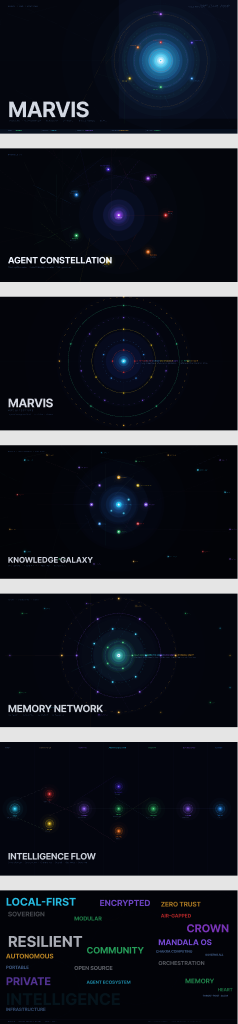
The Agent Constellation
MARVIS is organized around a constellation of five specialized agents — each with a defined domain, a specific relationship to the user's context, and a governance protocol that determines when and how it acts. The agents don't compete for priority; they orbit the central intelligence, each active in its domain, each capable of coordinating with the others when the task requires it.
The constellation metaphor is not decorative — it reflects the architectural reality: no single agent is the system. The intelligence emerges from the relationships between agents, the knowledge they share, and the memory they collectively hold. MARVIS is the gravitational center; the agents are what it keeps in orbit.
Knowledge Galaxy and Memory Network
MARVIS maintains two distinct forms of persistent context. The Knowledge Galaxy is the structured knowledge base — factual content, reference material, domain knowledge, and the accumulated documentation of how my systems work. It is searchable, citable, and organized for retrieval.
The Memory Network is different. It holds episodic and procedural memory — what happened, what was decided, what patterns have emerged across time. Memory is not the same as knowledge: knowledge is what is true, memory is what was experienced. MARVIS uses both, and the distinction between them is architecturally enforced rather than collapsed.
Intelligence Flow and the V7 Safety Triad
Intelligence Flow is the coordination layer — how the MARVIS constellation routes tasks, escalates decisions, and handles handoffs between agents. It operates under the V7 Safety Triad: three governance principles (Root, Solar, Crown) that determine what the system can do autonomously, what requires confirmation, and what is always a human decision.
The Safety Triad is the explicit answer to the question that haunts every autonomous AI system: what does this system refuse to do without asking? The answer is architectural, not behavioral — built into the routing logic of Intelligence Flow, not left to the judgment of any individual agent.
Mandala OS — the design framework
MARVIS operates within Mandala OS — the Chakra Computing Framework that governs how five Mandalas (domains of practice) interact through a unified slash command language. The Mandalas are not apps; they are coherent domains of intelligence — each with its own knowledge, its own agent relationships, and its own interface conventions. MARVIS is what gives them all a shared intelligence layer.
The Mandala structure reflects a philosophical commitment: intelligence should be organized around domains of human meaning (the Mandalas), not around computational convenience. The system serves the domains; the domains don't serve the system.
Key Design Decisions
The MARVIS design principle is not "we prefer local" — it is "local is the default, and external is an explicit choice with explicit consent." Data at rest is local and encrypted. Processing defaults to local models where capability allows — the live stack runs Gemma and Ollama for on-device language intelligence, handling tasks where cloud processing would expose private context. Cloud services are used for specific functions where they provide irreplaceable value, and those functions are isolated from the core intelligence layer. Sovereignty is not a feature; it is the architecture.
Most AI memory systems conflate what the AI knows (knowledge) with what it has experienced (memory). MARVIS separates these architecturally because they have different reliability characteristics, different update patterns, and different appropriate uses. Knowledge is updated deliberately and vetted for accuracy. Memory is accumulated continuously and held with appropriate uncertainty. Using the wrong type in the wrong context produces either hallucination (treating memory as knowledge) or rigidity (treating knowledge as memory).
The V7 Safety Triad is not a policy document or a set of behavioral constraints applied to an already-designed system. It is part of the routing architecture — the flow of intelligence through MARVIS passes through the Safety Triad at every escalation point, so the governance is intrinsic to the intelligence flow rather than external to it. This is the same design principle as JAY Astral's consent architecture: values in the build, not in the disclaimer.
MARVIS is modular because the problem requires modularity. A monolithic personal AI system that holds all functions in a single runtime is a single point of failure — for reliability, for privacy, and for capability. By distributing intelligence across a constellation of agents with defined domains and interfaces, MARVIS can evolve individual agents without disrupting the whole, can isolate sensitive domains from general-purpose ones, and can incorporate new capabilities without redesigning from scratch.
Current State
MARVIS is in active development as the intelligence layer of the live operational stack — alongside EOS (execution), Notion (operational editing), and Claude Code (sync bridge). The Agent Constellation, Knowledge Galaxy, and Memory Network are all operational; the full Intelligence Flow and complete V7 Safety Triad implementation are in progress.
MARVIS represents the most technically ambitious piece of the portfolio — an attempt to solve the genuine hard problem of personal AI: intelligence that is powerful, private, persistent, and accountable to the person it serves. For any team working on AI infrastructure, local-first systems, or agent orchestration: this is the conceptual and architectural work I bring.