The Problem
Two questions held together, one craft and one ethical.
The craft question: can a "transition" carry wonder through sameness rather than spectacle? Can the most moving moment in an experience be the discovery that nothing changed — only the way it's rendered?
The ethics question, which is louder now than when I started building: as interfaces use camera and microphone to sense us — to read our breath, our hands, our presence — what does trustworthy embodied interaction actually look like in practice? Not as a privacy policy. In the architecture of the thing itself.
These two questions share a single answer: restraint. The design that earns the most trust is the one that takes the least without asking.
What I Designed
The crossing — wonder by sameness
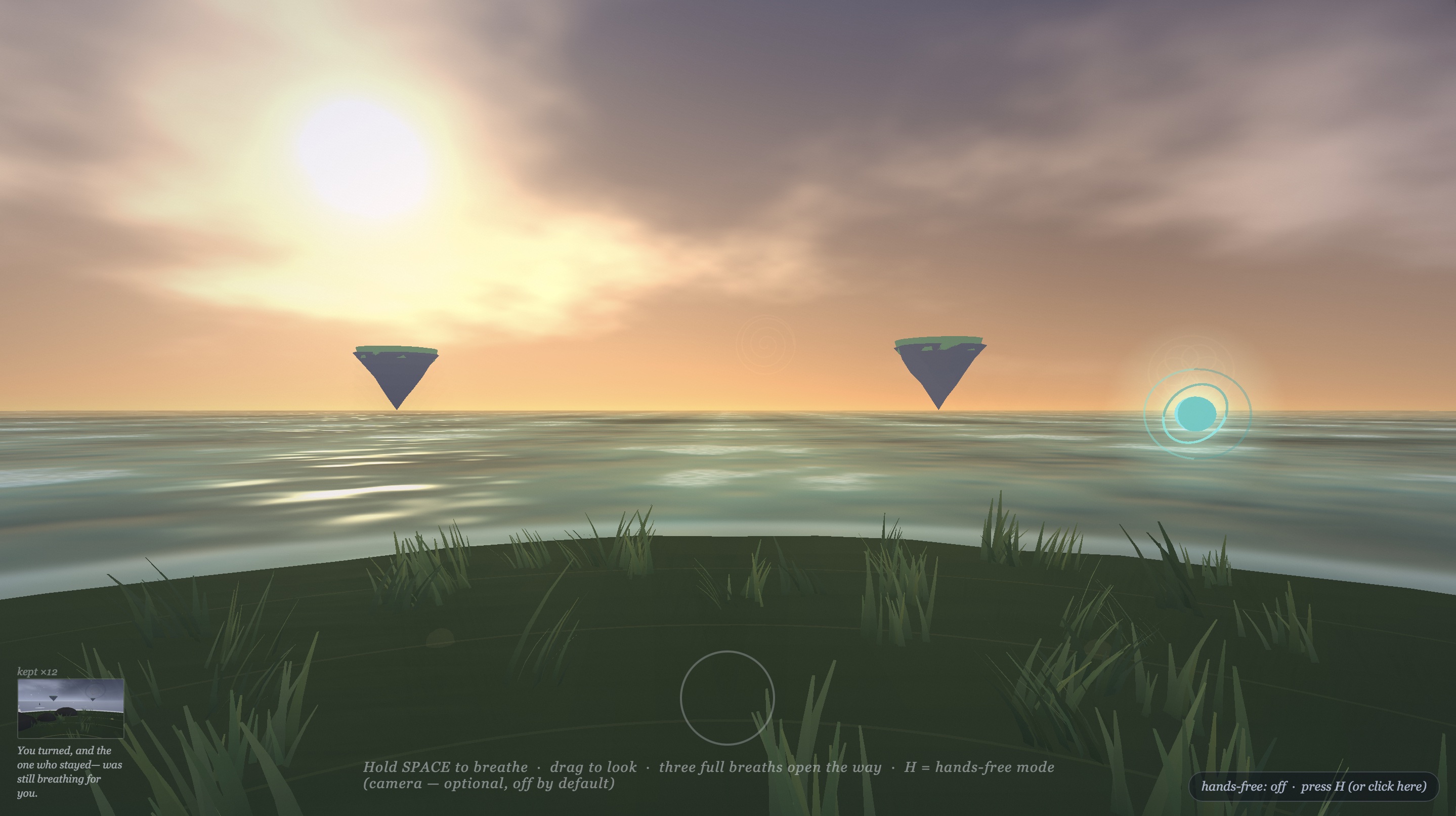
Three full breaths carry you from a waking cliff into the same cliff, remembered. The core is deliberately tiny: three state values and a breath. The transition is the exhale — never a cut, never a portal. The restraint is the whole design language.
The riskiest creative call: make the climactic moment quiet. The waking cliff and the remembered cliff are the same geometry, differently rendered — not a spectacular new world, but a subtle shift in how the same world feels. It's a designed bet on trust in the user's attention. Either they feel the difference, or the piece fails. Most people feel the difference.
Privacy-first embodied interaction
An optional hands-free mode reads breath (mic) and hand mudras (camera) to drive the experience. Every choice in this system was built around consent and dignity:
- An explicit consent card explains exactly what's read, in plain language, before the browser's own permission prompt — so the user knows what they're agreeing to before the browser asks.
- Everything is processed locally. Nothing is recorded or sent. This is not a privacy policy aspiration — it is the architecture of the thing.
- "Off is off." Disabling the hands-free mode actually stops the hardware tracks. No quiet lingering in the background.
- If you choose to film your crossing, you keep the footage — it never leaves the machine.
The consent architecture is the part of this project I'd put in front of any team building human-facing AI that reads the body. It is replicable, principled, and technically honest.
Systems that remember, gently
The world accrues quiet history across sessions. The sky wears where you've gazed — a subtle darkening in regions of sustained attention. The water grows one ring per crossing. "Recognition" builds across sessions until the two registers converge — a moment called "The Return."
This is persistence as emotional design, not as a scoreboard. The world isn't tracking you; it's developing a texture that reflects your use of it. The distinction matters in ways that are hard to articulate but immediately felt.
Depth without noise
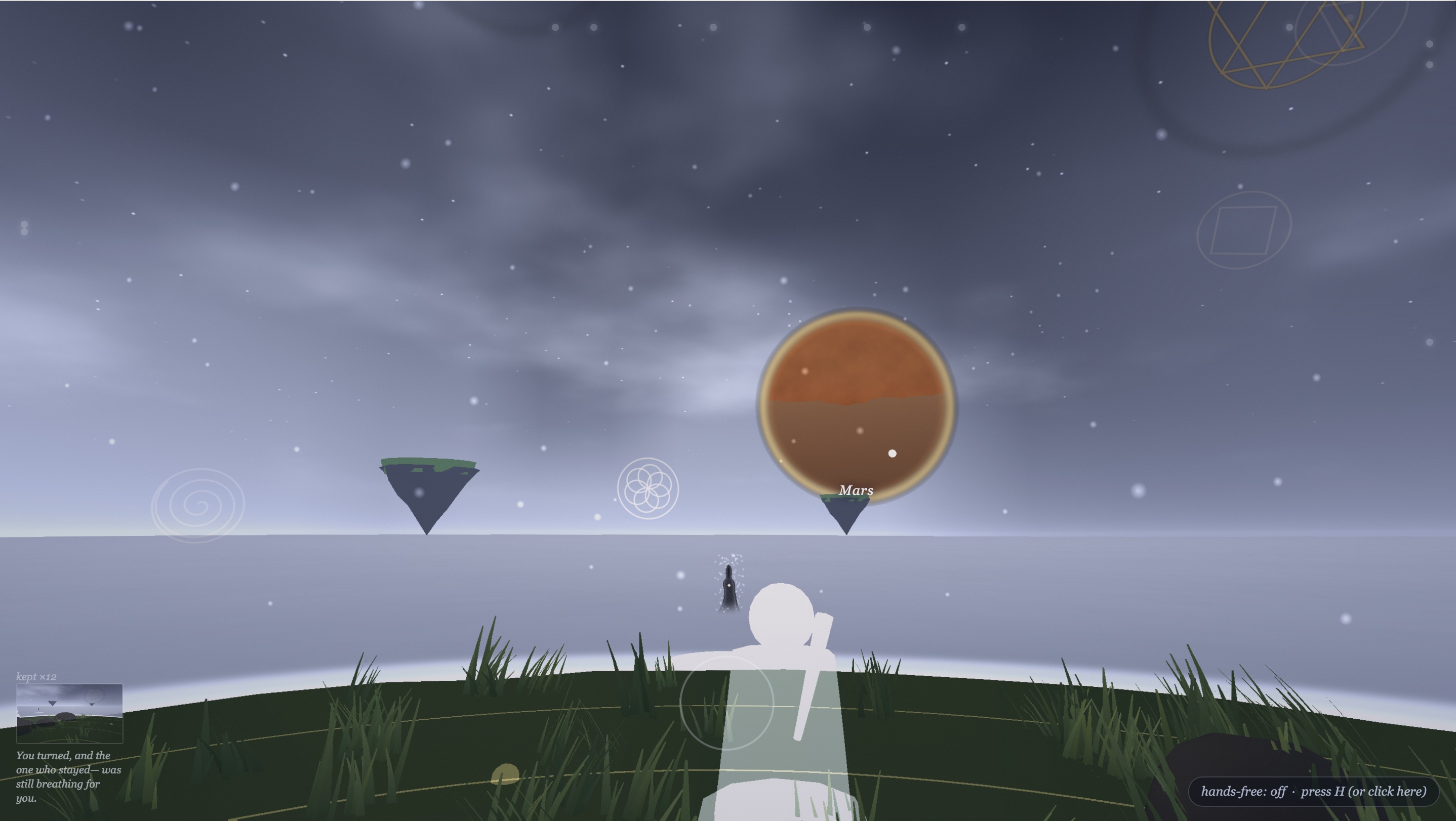
A gaze-and-breath window system opens procedurally-rendered vistas — Moon, Mars, Europa, Solaris, Dream, Higher/Lower Astral, Federation, Sanctuary. Several are enterable as small self-contained worlds, all reachable by looking and breathing, never by menus. No fail state. Hints return only when you seem genuinely lost, not on a timer.
Key Decisions
The camera and mic features are powerful. I gated them behind explicit, plain-language consent and made "off" genuinely off. The restraint is the feature — not something that weakens the experience, but what makes the experience trustworthy enough to be felt fully.
The climactic moment is quiet by design. This is the hardest call to defend before you experience it, and the easiest to defend after. It's a bet on the depth of the user's attention — that they will feel the shift in rendering as emotionally significant even though "nothing happened."
Privacy claims in consumer tech are usually policy claims. Here it's an architectural claim: the pipeline is structured so that even if someone wanted to, recording or transmitting would require changing the architecture, not flipping a flag. This is the difference between "we don't collect" and "we can't collect."
An earlier spec promised "the AI companion stays behind" at the crossing. As the work grew, the companion came to accompany you across — which felt truer to the experience. I let the build tell the truth rather than preserve a nice line in a spec document. Honesty in evolution is also an ethics stance.
Outcome
A completed, running experience that is, as much as anything, a demonstrable artifact of ethical AI-interaction design: sensing the body while keeping the person in full control of their data. Values shipped, not stated.
For any team working on responsible AI, embodied interfaces, or calm technology, it's evidence that the privacy architecture and the user experience are not in tension — they are the same thing, designed from the same premise: the human stays in control.
Reflection
JAY Astral is a proof of a specific claim: that you can build AI that reads the body — powerfully, usefully — while keeping the person in full control and building genuine trust. The claim is more valuable than the experience. The experience is the proof.
The consent architecture here is the piece I'd most want to turn into a reusable design pattern. The structure — plain-language pre-consent before the browser prompt, local-only processing, genuine hardware stop, user ownership of any generated data — is repeatable. It doesn't require extraordinary engineering. It requires the decision to do it.
Next: host for a shareable link, and write the consent/embodiment pattern as a design guideline. It belongs in the world beyond this project.