The Problem
Intentional communities — organized around shared values, practices, or purpose — have a fragmentation problem. They exist across platforms: Slack groups, Discord servers, Meetup events, Instagram accounts, WhatsApp threads, in-person gatherings. A person who belongs to several of them has no single place where their community life is legible. Each platform shows a fragment. The whole remains invisible.
There is also a lifecycle problem. People join communities and then drift. Life changes — a move, a new job, a shift in circumstances — and the daily practice that held someone in a community dissolves. The community still exists. The person still wants to belong. But there's no graceful re-entry path, no "finding my way back" experience designed into the product. Most community infrastructure is designed for acquisition and activation, not for continuity and return.
TribALL was designed to address both problems: fragmentation across platforms, and the absence of a designed return path for people who've drifted.
What I Designed
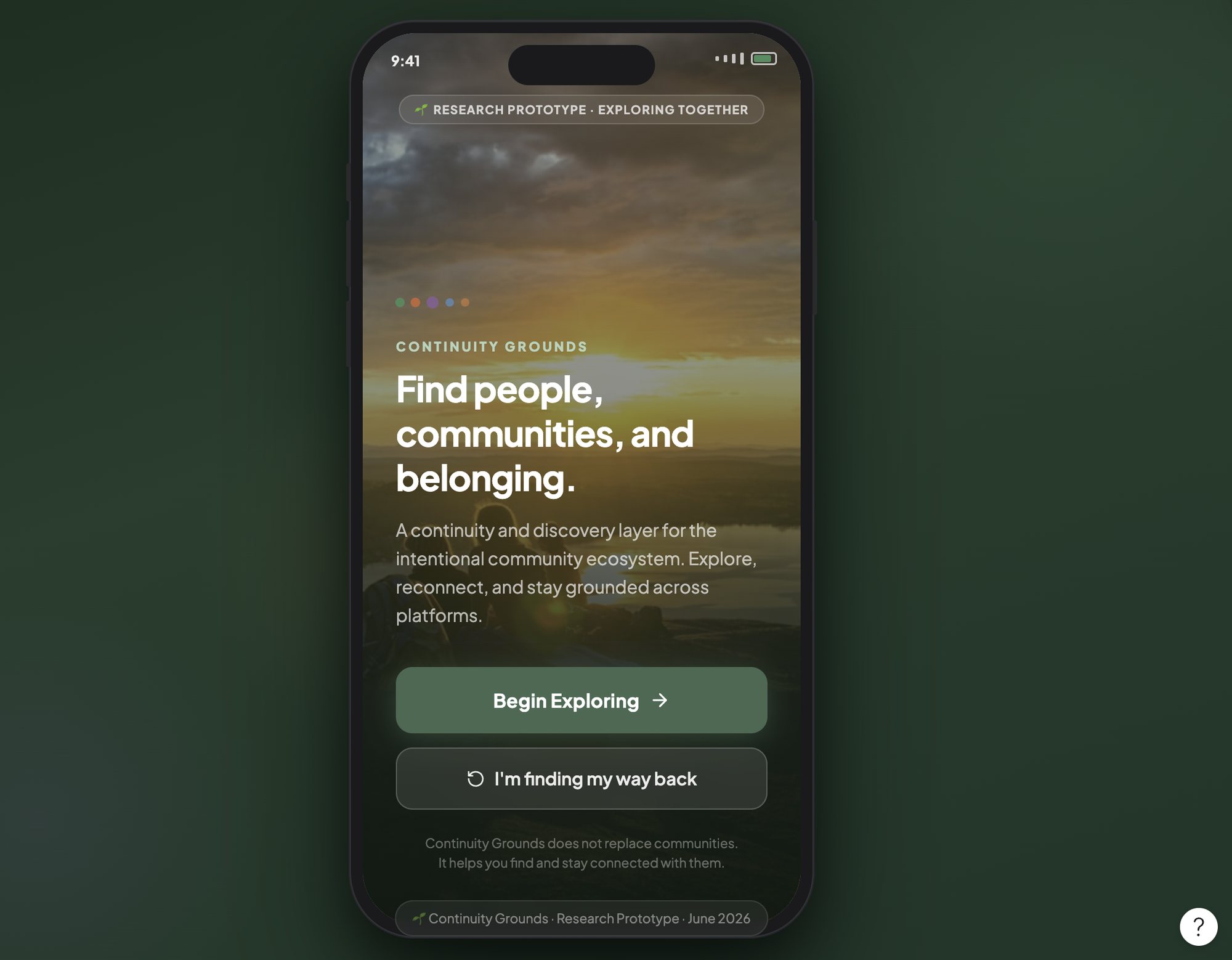
A dual-entry front door
The first design decision visible in the prototype is the most important one: the landing screen presents two equally weighted paths. "Begin Exploring" for someone looking for new communities. "I'm finding my way back" for someone returning to ones they've drifted from.
These are distinct user states with distinct emotional registers. The person discovering communities for the first time is open, curious, and uncertain about what to look for. The person finding their way back knows what they lost and is navigating something closer to grief — a sense that the connection existed and then went quiet. Giving "I'm finding my way back" its own primary CTA, rather than treating it as an edge case inside "Begin Exploring," is a statement that both states are first-class citizens of the product.
This is also a retention strategy that most community products don't have: a designed return path that acknowledges lapse without punishing it.
Cross-platform continuity layer
TribALL is designed as a layer that sits above community platforms — aggregating, connecting, and surfacing community life across the platforms where it actually happens. The app maintains connection to a person's community ecosystem even when no individual platform is providing continuity.
The intentional community ecosystem is itself distributed across many platforms; designing a product that pretends otherwise would be designing for a world that doesn't exist. TribALL is designed for the world that does: fragmented, multi-platform, and requiring a coordination layer to feel whole.
Visual language — grounded and expansive
The visual design uses a full-bleed landscape photograph — a dramatic sunset over open terrain — as the backdrop for an experience about finding and maintaining belonging. The aesthetic is deliberate: community at a human scale has always been tied to place, to shared physical context, to the feeling of being somewhere together. The landscape signals that even in a digital platform, something elemental is at stake.
The multi-colored dots in the header (red, orange, purple, blue, green) represent the spectrum of community types — different values, different practices, different contexts — that a single person might belong to. The visual says: this is a diverse ecosystem, and you belong to more than one part of it.
Button color is deliberate: the "Begin Exploring" CTA uses a deep forest green — grounded, rooted, steady. Not the energetic call-to-action blue of most apps. This is about belonging, not conversion.
Key Decisions
Most community products have an onboarding flow and then an ongoing experience. Neither is designed for re-entry after drift. Making "I'm finding my way back" a primary CTA — with the same visual weight as "Begin Exploring" — means the product is explicitly designed for lapse and return. This is rare in community product design, and it's the decision that would most distinguish TribALL from generic community discovery apps.
"TribALL does not replace communities. It helps you find and stay connected with them." This disclaimer — displayed on the landing screen, without being hidden in an about page — is a positioning decision and a design principle simultaneously. It sets the boundary of the product's ambition precisely: not another platform competing for community life, but infrastructure that connects community life where it already is. This is a rare example of product honesty built into the entry experience.
The hardest architectural decision in any community product is whether to be a platform (where community life happens) or a layer (that connects community life happening elsewhere). Platforms compete with every community tool a person already uses. Layers support them. TribALL chose to be a layer — which is both a more honest product (the community doesn't live here) and a harder product to design (the value has to be visible without being the place where the value happens).
Using a real landscape photograph as the backdrop of an app about community is a deliberate bet on emotion over abstraction. The person using TribALL is looking for something that feels like it has stakes — belonging, connection, shared ground. The landscape says: this matters. It doesn't have to be clever. It has to feel true.
Not Yet Validated
The TribALL flows, UI patterns, and product decisions shown here have not been tested with users. No formative or summative research has been conducted with target populations. The dual-entry model, cross-platform layer positioning, and visual language are design intent — not evidence-based conclusions.
Next step: Recruit 5–8 people actively navigating community drift or rediscovery for moderated concept testing sessions before any development commitment.
Outcome (research prototype state)
A research prototype completed June 2026, demonstrating the core concept: dual-entry (explore vs. return), cross-platform layer positioning, and a visual language designed to signal belonging rather than acquisition.
TribALL represents a design thesis that extends across my broader work: the most valuable thing a platform can do is hold the connections that can't hold themselves. Not build the community, but sustain it through the natural disruptions of a human life. That's a design problem with no obvious technical solution — it requires empathy, restraint, and a willingness to let the product be small so the community can be large.